New Prince Shri Bhavani College of Engineering and Technology
The Department of Electronics and Communication Engineering (ECE) was established in 2008 with the vision of producing globally competent engineers committed to serving society. The department currently offers a four-year B.E. program in Electronics and Communication Engineering with an intake of 180 students.
The department is equipped with state-of-the-art laboratories covering diverse domains such as Electronic Devices and Circuits, Digital Electronics, Linear Integrated Circuits, Microprocessors and Microcontrollers, Digital Signal Processing, Communication Systems, VLSI, Embedded Systems, Optical and Microwave Engineering. These facilities provide students with hands-on experience across a wide range of hardware platforms and advanced software packages. To further enrich learning and research, the department houses the J.C. Bose Research Laboratory and the Tesla Tech Hub, alongside industry-supported laboratories including the Intel Intelligent Systems Lab, Retech IoT Lab, and Tessolve Semiconductor Lab.
A team of dedicated and knowledgeable faculty members with expertise in Applied Electronics, Communication Systems, VLSI, Embedded Systems, Computer Communication, and Networking form the academic backbone of the department. Beyond academics, students are encouraged to develop professional and soft skills through active participation in associations and chapters such as Fuerza, IEEE, IETE, ISTE, IEI, and CSI.
The ECE department is committed to academic excellence, innovation, and the holistic development of students. Our curriculum is designed to provide a strong foundation in core areas such as electronics, communication systems, signal processing, VLSI, embedded systems, and emerging technologies, while also encouraging practical learning and research-oriented thinking.
We are supported by a team of well-qualified and dedicated faculty members who strive to impart quality education through effective teaching methodologies, hands-on laboratory work, industry interaction, and continuous mentoring. The department emphasizes skill development, ethical values, teamwork, and lifelong learning to prepare students for successful careers in industry, higher education, and research.
We continuously encourage our students to participate in technical events, internships, projects, and professional activities that enhance their knowledge and confidence. Our goal is to nurture competent engineers who can contribute meaningfully to society and meet global technological challenges.
I warmly invite students, parents, and stakeholders to explore our department and be a part of our journey toward excellence.
Dr. G. Durgadevi, M.E., Ph.D.,
Dean-Academics & Head of the Department,
Department of Electronics and Communication Engineering,
New Prince Shri Bhavani College of Engineering & Technology.
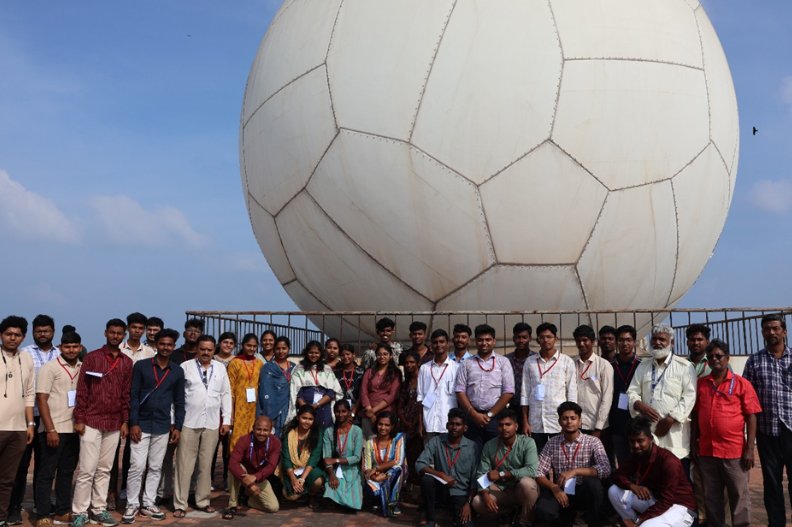
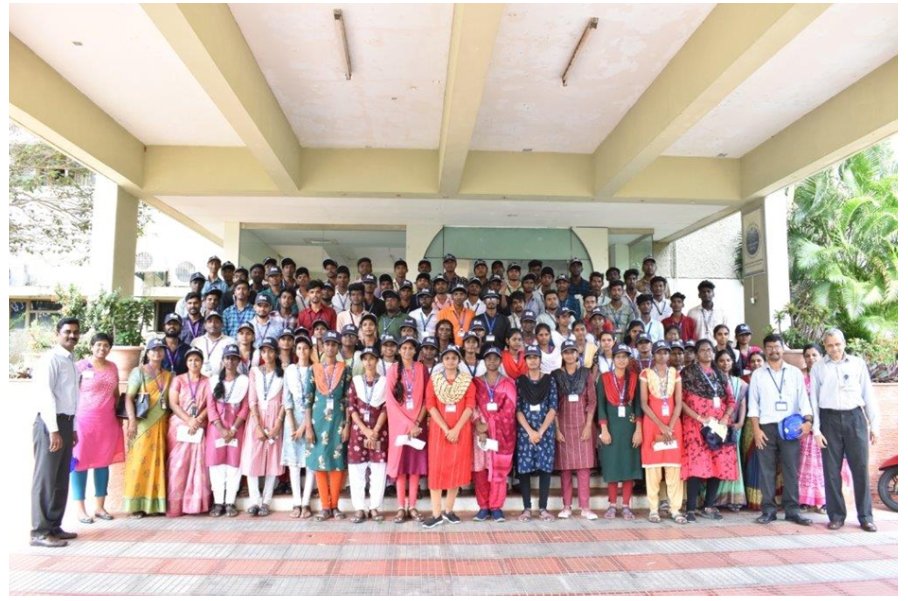
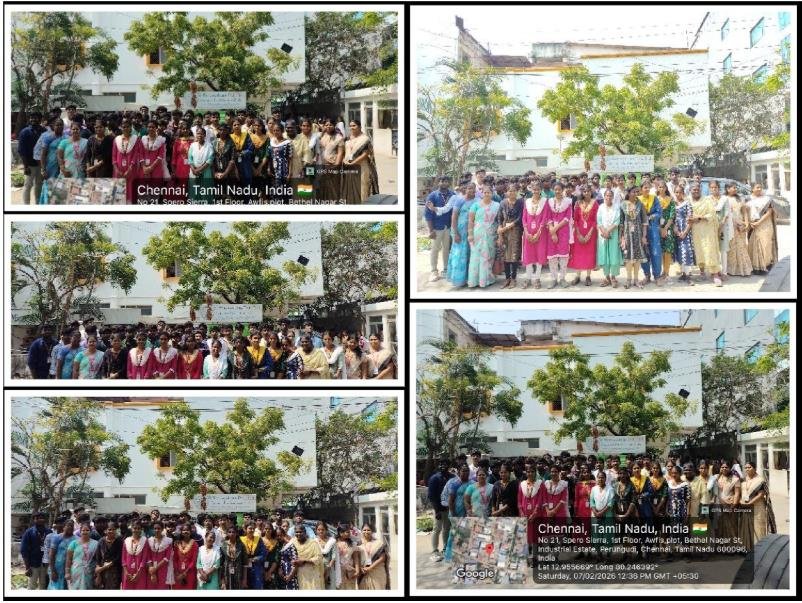
II year and III year students of ECE Department visited Madras Atomic Power Station (MAPS), Kalpakkam as part of an industrial visit, gaining valuable insights into power generation and safety systems
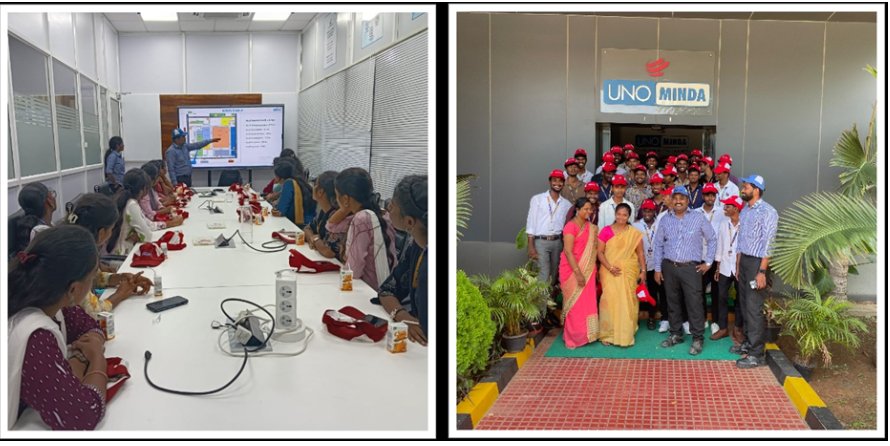
III year students of ECE Department visited UNOMINDA, Sriperumbudur as part of Industrial Visit
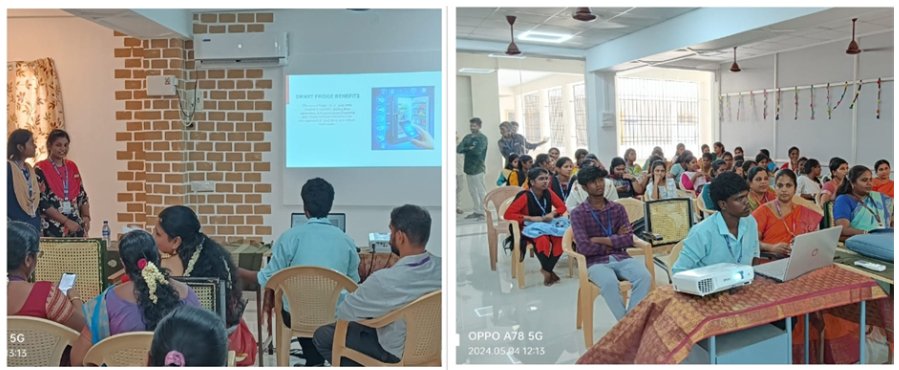
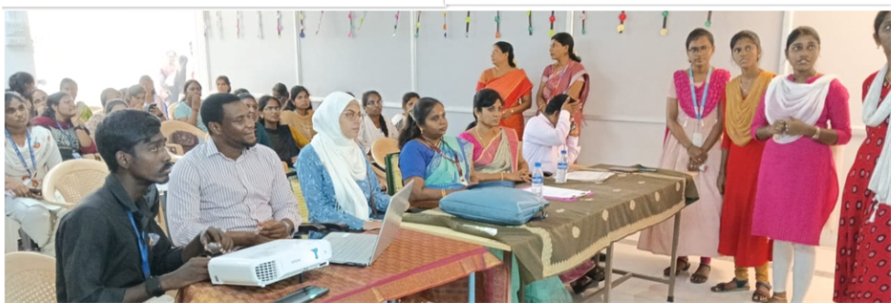
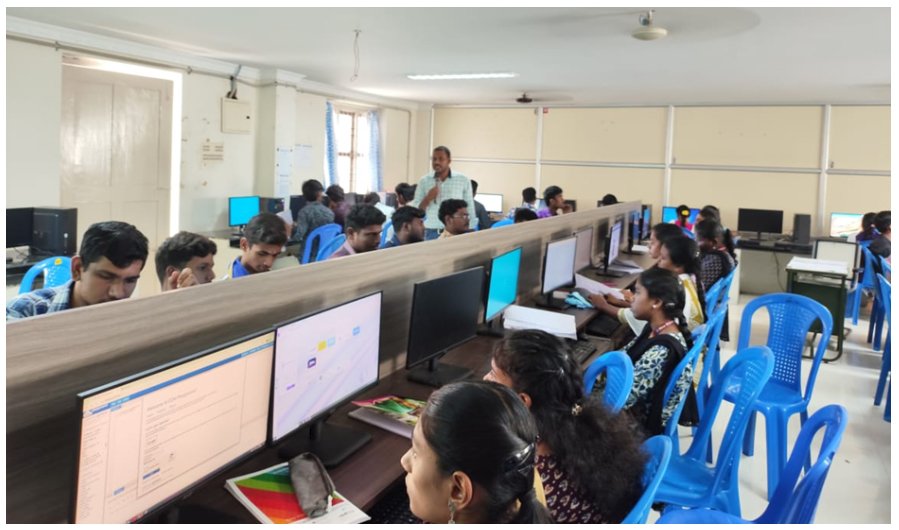
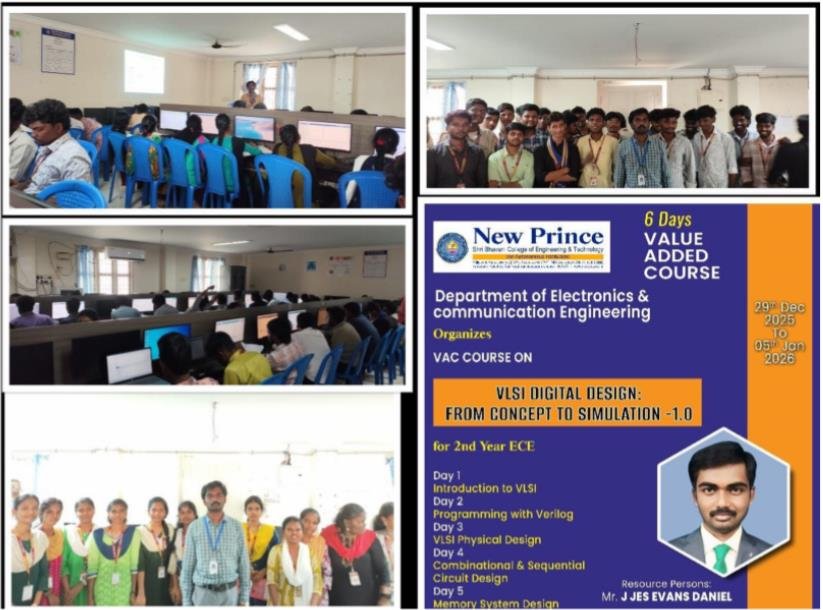
Department of ECE Organized VAC COURSE on “VLSI DIGITAL DESIGN: FROM CONCEPT TO SIMULATION -1.0” for III and II year ECE students handled by Taras Systems and Solutions, Coimbatore.
The Department of Electronics and Communication Engineering organized an industrial visit to Vee Technologies, Chennai, for II and III year students. The visit provided exposure to industry practices, real-time projects, and domains like IT services and engineering solutions. It helped students understand practical applications and prepare for future career opportunities.
The Value Added Course “VLSI Digital Design: From Concept to Simulation – 1.0” was conducted for II ECE students in collaboration with Taras Systems and Solutions. The course provided fundamental knowledge of VLSI design, Verilog, and hands-on simulation experience. It helped students gain practical skills and better prepare for careers in the VLSI domain.
The Department of EEE is committed to providing high-quality technical education and nurturing competent electrical engineers to meet the evolving demands of industry and society. Our department offers a strong academic foundation combined with practical exposure in the areas of power systems, electrical machines, control systems, power electronics, renewable energy, and emerging technologies.
We are supported by a team of highly qualified, experienced, and dedicated faculty members who are actively involved in teaching, research, training, and mentoring students. The department is well equipped with modern laboratories, advanced software tools, and learning resources that enable students to gain hands-on experience and industry-relevant skills.
To enhance overall student development, the department regularly organizes workshops, industrial visits, guest lectures by industry experts, value-added courses, technical symposiums, and training programs. Emphasis is given to project-based learning, innovation, research activities, and entrepreneurship. Our students are encouraged to participate in co-curricular and extracurricular activities, professional bodies, and community-oriented programs.
The department focuses on achieving excellent academic results, placements, and higher education opportunities by fostering critical thinking, ethical values, teamwork, and leadership qualities. We strive to create a learner-centric environment that motivates students to become responsible engineers and lifelong learners.
I warmly invite students, parents, alumni, and industry partners to explore our department and join us in our mission to achieve academic excellence and professional success.
Best wishes,
Dr. R.Venkatasubramanian, M.E, Ph.D,
Professor & Head of the Department
Electrical and Electronics Engineering
New Prince Shri Bhavani College of Engineering & Technology
• To produce globally competent Electronics and Communication Engineers with a commitment to serve the society.
M1. To establish a conducive learning environment to meet the demands of society.
M2. To provide cutting-edge technical education to produce engineers with the highest calibre of professionalism.
M3. To encourage creative thinking and support research to use technology to enhance people’s quality of life.
M4. To provide high quality, ethical engineers for the good of society.