Department Info
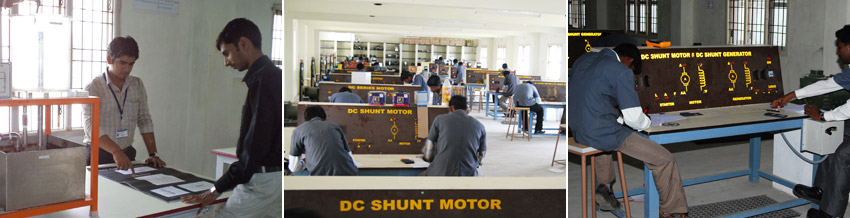
The Department of Electrical & Electronics Engineering (EEE), started in 2008, has a team of highly qualified and experienced faculty. With its exceptional infrastructure, the department accentuates on sound practical knowledge, while nurturing creativity in the student community. Department of EEE deals with the problems, opportunities and needs of Electrical, Electronics, Computer, Control systems and related industries. This programme uses the concept of Science, Technology, and Problem-solving skills to design, construct, and maintain products, services, and information systems. This programme prepares students for careers as Design Engineer, Project Engineer, Engineering Specialist, Chief Engineer, Quality Control Engineer, Software Engineer, Development Engineer, Reliability Engineer, Research Engineer, Systems Design Engineer, Field Engineer, Test Engineer and Sales Engineer etc. Electrical Engineering serve as a starting point for the careers in many other diversified fields, ranging from Instrumentation Engineering, Energy Engineering, Computer Science and Engineering, Biomedical Engineering and Aerospace Engineering.
The department has published over 25 journal papers in the past two years. All the faculty and students have the possibility to participate in the research activity through their internally constructed Project Lab, Industry Supported Lab and Research Lab, publish the papers in refereed journals/conferences. The students are provided with opportunities for the training program of reputed industries, professional societies, research organizations and academic universities. The Institution is strategically supports the industry interaction with Electrical and Electronics industries, that will bring more opportunities to the students.
It has signed MoU with top industries like Retech Solutions Pvt. Ltd., Tessolve Semiconductors Ltd., ,Goodwin motors ,eDGIM Research Pvt Ltd, etc., to conduct industry relevant R&D and internships for students. Faculty and students are actively involved in innovative, sponsored research projects. The major R&D projects for funding applied to the government organizations such as AICTE, DST-SERB and MNRE. The expertise of the faculty is also reflected with the good number of Patents being filed.
Our objectives are to use the above experience to perform collaborative research with industry and to improve student outcome through teaching, research, development and training in the emerging technologies.
VISION:
To produce globally competent Electrical and Electronics Engineers who can cater to the contemporary needs of the Industry and Society.
MISSION:
M1. To provide a good infrastructure and a serene environment to cater the curriculum requirements of Electrical and Electronics Engineering.
M2. To motivate students and faculty towards research activities in association with industries.
M3. To provide a conducive environment for students to enhance their co-curricular, soft skills and ethical values for their career development.
M4. To stimulate continuing education for creating quality engineers towards sustainable improvement in the society.
PROGRAM EDUCATIONAL OBJECTIVES (PEOs)
Within three to five years, our graduates of Electrical and Electronics Engineering program are expected to:
PEO1: Procure optimum solution for electrical engineering problems in order to cater successful professional career.
PEO2: Demonstrate creativity in the engineering practices including entrepreneurial and collaborative ventures with strategic thinking planning and execution for lifelong learning.
PEO3: Exhibit to communicate effectively, recognize and incorporate societal needs and constraints in their professional endeavors and practice the profession with high regard to legal and ethical responsibilities
PROGRAM OUTCOMES (POs):
PO1: Engineering knowledge: Apply the knowledge of mathematics, science, engineering fundamentals, and an engineering specialization to the solution of complex engineering problems.
PO2: Problem analysis: Identify, formulate, review research literature, and analyze complex engineering problems reaching substantiated conclusions using first principles of mathematics, natural sciences, and engineering sciences.
PO3: Design/development of solutions: Design solutions for complex engineering problems and design system
components or processes that meet the specified needs with appropriate consideration for the public healthand safety, and the cultural, societal, and environmental considerations.
PO4: Conduct investigations of complex problems: Use research-based knowledge and research methods including design of experiments, analysis and interpretation of data, and synthesis of the information to provide valid conclusions.
PO5: Modern tool usage: Create, select, and apply appropriate techniques, resources, and modern engineering limitations.
PO6: The engineer and society: Apply reasoning informed by the contextual knowledge to assess societal, health, safety, legal and cultural issues and the consequent responsibilities relevant to the professional engineering practice.
PO7: Environment and sustainability: Understand the impact of the professional engineering solutions in societal and environmental contexts, and demonstrate the knowledge of, and need for sustainable development.
PO8: Ethics: Apply ethical principles and commit to professional ethics and responsibilities and norms of the engineering practice.
PO9: Individual and team work: Function effectively as an individual, and as a member or leader in diverse teams, and in multidisciplinary settings.
PO10: Communication: Communicate effectively on complex engineering activities with the engineering community and with society at large, such as, being able to comprehend and write effective reports and design documentation, make effective presentations, and give and receive clear instructions.
PO11: Project management and finance: Demonstrate knowledge and understanding of the engineering and management principles and apply these to one’s own work, as a member and leader in a team, to manageprojects and in multidisciplinary environments.
PO12: Life-long learning: Recognize the need for, and have the preparation and ability to engage in independent and life-long learning in the broadest context of technological change.
PROGRAM SPECIFIC OUTCOMES (PSOs):
Students of the Electrical and Electronics Engineering Program:
PSO1: Shall have Potential to analyze, design, synthesize and provide technical solutions in the field of Power Generation, Distribution, Renewable Energy systems and Embedded Systems.
PSO2: Shall exhibit leadership skills and pursue entrepreneurship and contribute in the field of Electrical and Electronics Engineering.
[elementor-template id=”22353″]
[elementor-template id=”21614″]
[elementor-template id=”22174″]
[elementor-template id=”22072″]
[elementor-template id=”22093″]
[elementor-template id=”22908″]
[elementor-template id=”22860″]
[elementor-template id=”20769″]
[elementor-template id=”20940″]
[elementor-template id=”20988″]
[elementor-template id=”21034″]
[elementor-template id=”21045″]